Another city, not my own

As a born and bred Aucklander I have the right to have mixed feelings about my home town if not diss it outright, but sitting here as I am on the other side of the world it's still difficult to watch the feckless wholesale fuck-up that is the Rugby World Cup. More specifically, it's difficult to watch the greed, mismanagement and small-town, me-too overreaching of New Zealand officials who would sell their grandmother and not even at a good price to satisfy their fantastical imaginations about what possible tourists might possibly want from the event. To wit, one Murray McCully, many years in bumbling opposition but now finally with his tiny hands on the tiller, agitating for legislative approval in the dead of summer in order to reshape one of the most beautiful working waterfronts in the world into a typically fucked up, hasty, shit-ass -- let's say it: typically Auckland collapse of architecture. Aucklanders don't need it, tourists don't want it, six out of 13 city councillors can't even be fucked turning up to debate it and the country won't profit from it, but hardworking little eager beaver Murray is pushing for it in what has become trademark National / John Key style: in secret, under the table, behind closed doors, under urgency. This is what Auckland has come to: John Banks as the voice of reason. As always, catching the blood from the stone are local architectural compromisers Jasmax.

It reminds me of certain other well-earning men who fronted up in the 1980s with business talk of a trickle-down economy and "economic benefits" that never materialised for anyone but themselves. Massive over-capitalisation, skyhook "business" jargon, a shit-eating grin, a perennial loss flicked off to the ratepayers and government-funded retirement for Wellington MPs' sunset years while one of the prettiest cities in the southern globe lies pebble-dashed in their wake. Auckland: the boom times are back.

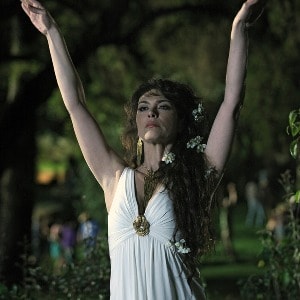
"So you, personally, aren’t a psycho, right?"

Noir and B-movies are filled with actresses who specialised in one type of role. My favourite horror pin-up is Barbara Steele, she of Black Sunday (AKA The Mask of Satan). I saw it as a kid and was never quite the same way again. Steele always reminds me of Michelle Forbes: both actresses share an underbite, an eight-ball stare and a frangible quality.

In other words, Forbes is a character actor - the exact tool for a certain type of job. Her roles are typically noirish, dead-end and hard to love, but they also have their negative qualities. Forbes has appeared in in 24, Ronald D. Moore's terrific remake of Battlestar Galactica and, most recently, in True Blood. Each time she appears in viewers notice her, say she's really good, and then forget her. But I have a feeling she's going to be on T-shirts for a couple of generations. Here's a quote from the actress and a link to a good interview on New York magazine:
"For whatever reason, every project I do becomes sort of a cult, or a cultish show, you know, like Battlestar, or even a film I did years ago, Kalifornia, people refer to it as a cult film."
Michelle Forbes interview.

Literature now (then)

From New York magazine:
"This, in a nutshell, is the problem of the aughts. Will all of these newly indispensable textual forms ever lend themselves to actual books, or are they simply ends in themselves?"

Read more: Sam Anderson on When the Meganovel Shrank

iPlot

When you are writing it becomes harder to find new things to read so I was pleased to discover novelist Shusaku Endo, a stranger to me despite being translated into twenty-eight languages (I read only one) and being nominated more than once for the Nobel Prize. Endo was one of Japan's post-war 'Third generation' authors, a group identified with the Japanese tradition of the autobiographical "I-novel". He was Catholic and as a student in 1950 spent several years studying in Paris. Foreign Studies is a collection of three associated stories about a Japanese student and a university lecturer finding their respective ways through Normandy and Paris.

In Haruku Murakami and the Music of Words, translator Jay Rubin writes much about the form of the "I-novel", describing Murakami as Japan's "first genuinely 'post-post-war writer', the first to cast off the "dank, heavy atmosphere' of the post-war period." If Rubin is correct, then Endo must be one of the authors to whom Murakami stands in contrast. Endo's tone reminded me of Graham Greene; only after I looked it up did I learn that the two authors were often compared. Greene was a fan or at least wrote as such on the blurb for Endo's novel Silence. Well, duh.

I'm enjoying the outsider tone and locale of Foreign Studies. The Catholic thing doesn't sit with me: after years of art study I find Christian imagery depressing. I can only enjoy Greene's The End of the Affair by mentally running a red pen through the "saint" sub-plot, a hasty add-on that kills an otherwise modern novel, and Foreign Studies' first section, 'Summer in Rouen' suffers from the same dry work. (Crucifixions and tea cakes, one thinks: he gave up Shinto imagery for this?) The second, 'Araki Thomas' is a non-fiction jolt and a very post-modern shift in tone but part three about the Professor in Paris, 'And You, Too' lifted off. It has many things in fiction that I like: a stranger in the city, a sense of helplessness and disconnection and an atmosphere that all is not what it seems. I've yet to finish but with a set-up like that I'm sold. It's simple and resonant with possibilities.

Jazz Dispatch #1


The original Muse Lounge was opened in downtown Auckland in 1968 by a young couple from Antwerp, Cedric and Gretchen Hooves. Cedric Hooves was a qualified architect; Gretchen trained as a flautist and worked briefly as a photographic model before settling on a career in interior design. The newlyweds emigrated to New Zealand in 1967 to set up a business importing the latest European furniture, leasing commercial premises on Fanshawe Street to display their wares.

This new underground showroom, however, soon became better known as a place where writers, artists and musicians would gather to socialise with other members of Auckland's bohemian community. Together these loud and sometimes overly colourful crowds would smoke weed and listen to jazz into the small hours as they discussed the outre concepts of the day.

It was Gretchen who named these gatherings the Muse Lounge after the experimental fusion combo led by legendary drummer and vibes man Trip Checker. A jazz buff since childhood, Gretchen had followed the Muse Lounge since their first performances in Paris and Montreal. When the Muse Lounge proper opened a few blocks away on the corner of Wolfe and Albert Streets in 1970, Checker himself joined the house players for a fifteen minute improv set that included versions of 'Blue Skies / de Gier' and 'Gretchen's Hat', a fierce 7/4 workout dedicated to the young Mrs Hooves.

The property boom in Auckland's central business district saw the Muse Lounge move up to split-level premises in the Whyte Tower and a limited licence in 1976, but the ambience and the decor, famously, remain. For over thirty years the sculpted oval lobby of the Muse Lounge has been the first stop for young people, tourists and those in the know. Drop in any time after sunset and you'll find interesting people of all ages scattered across the bubble chairs and curving white couches. Cedric, grey haired in his kimono, still likes to drop into the sound booth and personally tweak the levels. Gretchen likes to take a seat by the bar where she can smoke and watch the crowd. All sorts of bands play there now but the place still has that twilight vibe. The girls smile and the boys tap their feet. Talk in the Muse Lounge makes music you hear nowhere else.

-- Janwillem Dorin, Jazz Dispatch / June 1999

Pere Lachaise, after visiting Jim, 30 Dec 2009


All by way of some sort of Christmas / New Year's card. Head down in the new ms. Like it always is. More fully formed ideas to follow.

Le Chat Noir