Pointlesse
February 21, 2010

The fact is that publishers do not need consumers to embrace higher prices because this move isn't intended to sell e-books, it's intended to sell more physical books.
 The last, last edit, Pete, is stacking up real neat - I'm thinking Wednesday next week, in the out box by Friday and then God knows what. A day's break and back into the three other manuscripts (I'm serious – count 'em) or maybe - or maybe something new. There's nothing else to do except work. Although today was the sort of day, to quote Colin MacInnes, that only an old whore like London could throw up. Sunny and everything, and the cafe where I do most of my work was empty. Everyone was outside grabbing the weather while they could.
 Good genre debate at io9.com. Writes Charlie Dane Anders @ io9:
Where would we be without genre labels? Free to write new and weird idioms, possibly. But a couple of recent blog posts make the case that genres aren't cages, they're toolkits that tell you how to read a particular text.
Science fiction may be literalization of metaphor, it may be open to metaphorical, symbolic and even allegorical readings, but what’s real within the story is real within the story, or there’s no there there.
Genre distinctions aren't useless - they are ways of signaling expectations to readers, and establishing reading conventions... I think the problem comes when we start reifying genre and assuming that the barriers between genres are somehow real and important barriers, rather than being useful human constructions that can be argued over and negotiated.
I love genre, because genres are basically conventions. They’re expectations that both authors and readers (and editors, and sales people) bring to a text—suggestions as to what should be inside, and how it should be arranged. And I dearly love conventions, because they’re the very stuff of communication, and of artistic structure—whether we’re obeying them, or departing from them.

It's tougher to be a young writer today than when I was a young writer. I don't think my first novel would have been published today as I submitted it. I don't think an editor would have read 50 pages of it. It was very overdone and shaggy, but two young editors saw something that seemed worth pursuing and eventually we all did some work on the book and it was published. I don't think publishers have that kind of tolerance these days, and I guess possibly as a result, more writers go to writing class now than then. I think first, fiction, and second, novels, are much more refined in terms of language, but they may tend to be too well behaved, almost in response to the narrower market.
INTERVIEWER: Should young writers be subsidized?VONNEGUT: Something's got to be done, now that free enterprise has made it impossible for them to support themselves through free enterprise.
 Can recommend the Faber director series' Woody Allen on Woody Allen as a very good book on writing. I have it in storage somewhere. When I was living in Brick Lane I managed to be drinking coffee when Woody Allen walked past: he was filming something just up round 'corner. Small, walks fast, and he really does wear that hat.
I had the idea about two women going away on a summer thing some place. Someone called from Barcelona and said ‘Would you like to make a picture here? We’ll finance it.’ That’s always the hardest part of making any picture, is getting the financing. Writing it, directing it, or anything else is easier than getting the financing for it, so I said sure, I would do it. I had no idea for anything for it, and then about a week or two later I got a call from Penelope Cruz. I didn’t know her, she wanted to meet, and she was in New York. I had only seen her in ‘Volver’ and nothing else ever. I thought she was great in it, and she said that she knew I was doing a film in Barcelona, and she would like to participate. I started out with Barcelona, with Penelope, and in the back of mind I was going to go to Scarlett. Then I heard Javier [Bardem] was interested, so gradually it took shape. I was writing for these people. I was deliberately writing for these people. I didn’t know Rebecca Hall at all. Juliet Taylor, my casting director, discovered her. She said that she was great, I should read her, and look at some film on her. I did and she was right. I put the thing together for the people almost, as I did it, and did the best I could.
I’m not sure the latter-day teenager would find comfort in Caulfield the way a few generations past have, because I suspect they are no longer exactly teenagers anymore. As a marketing concept, as a Twitter tribe, as girls who shop at Forever 21 and boys who skateboard, of course teenagers still exist. But as a true age of rebellion and confusion, adolescence went away with the 20th century.Tangentially, Adam Sternbergh in New York magazine decides that there is still a mass culture:
By now, we were all supposed to be happily imprisoned in our niches. You know: the theory that we’re all wagged by the long tail, each of us a microtargeted consumer absorbed in our narrowcast information flow. So if I love Animal Collective, the Golden State Warriors, Ron Paul, and Nutella, I can track down the four other people exactly like me, find our little corner of the Internet, and obsess in peace. So why was it that, for one cacophonous week at least, everyone seemed to be talking about just one of two things?
 EW weighs the possibility of a movie version of Catcher in the Rye now that difficult old J.D. Salinger is out of the way. Their speculation is fuelled by the novelist's comment in a 1957 letter:
“Firstly, it is possible that one day the rights will be sold. Since there’s an ever-looming possibility that I won’t die rich, I toy very seriously with the idea of leaving the unsold rights to my wife and daughter as a kind of insurance policy. It pleasures me no end, though, I might quickly add, to know that I won’t have to see the results of the transaction.”
Over the last ten years, Don DeLillo has become determined to solve one of the great riddles of the ancient art of storytelling: What is the slowest speed at which a plot can move before it stops moving altogether, thereby ceasing to function as a plot?...You could even say it’s something of a breakthrough: It brings us, in just over 100 pages, as close to pure stasis as we’re ever likely to get.
I think your instinct has to be to confront. If you're the kind of guy that comes to a peaceful lake and you know there's birds floating around on it and it's early morning or something and you're happy just standing there looking at that beautiful sight, then maybe you're a photographer.
 Charlotte Gainsbourg, who has that French thing of looking like a teenager and a 40 year old at the same time, interviewed on Time about her collaboration with Beck, among other things, ici.
 Some people the other night were praising Banksy's guerrilla art. I like Banksy too but he has a hard-working and very protective agent and licenses his works, neither of which is that guerrilla. The London guerrilla artist I really like is Slinkachu, who makes tiny street art. I've also discovered the work of W. Eugene Smith, who took photographs only from the window of his New York apartment. He also secretly recorded jazz greats. I wish I'd known about Smith years ago -- it would have saved me making up stories in that vein.
Neither Amazon nor other e-book retailers make any money on these giveaways either. But it is a way of luring customers to their e-reading devices. Free e-books are also a way of distinguishing a less-well-known author from the marketing juggernauts of the most popular books.Publishers -- and record companies -- have always given away free samples, but what is new about it this time is that they are doing so to attract subscribers to a device and network rather than readers to an author:
Book publishers, who rail against the dominance of Amazon and its insistence on discounting new releases to $9.99, are now playing the tech titans against each other.All the publishing notes from the above are from the IHT / NY Times but I read them in the print version first.
In the process, they may be rushing from the clutches of one tenacious chief executive, Jeffrey P. Bezos, into the arms of another, Steven P. Jobs, whose obstinacy over pricing has given the music industry similar paroxysms of anxiety.
“Will Kindle pricing trump Apple sex appeal? Isn’t that the question, really?” said Richard Charkin, executive director of Bloomsbury Publishing in London, who has been watching developments in e-book sales with keen interest. “I haven’t the faintest idea. All I would say is, great. The more people that are out there marketing books in digital or any other format, the better.”
 Judy Nylon clarifies Brian Eno's oft-quoted sleeve notes for his 1975 album Discreet Music:
So it was pouring rain in Leicester Square, I bought the harp music from a guy in a booth behind the tube station with my last few quid because we communicated in ideas, not flowers and chocolate, and I didn't want to show up empty-handed. Neither of us was into harp music. But, I grew up in America with ambient music. If I was upset as a kid I was allowed to fall asleep listening to a Martin Denny album…I think it was called "Quiet Village". The jungle sounds, played very softly made the room's darkness caressing instead of empty as a void. Pain was more tolerable. Brian had just come out of hospital, his lung was collapsed and he lay immobile on pillows on the floor with a bank of windows looking out at soft rain in the park on Grantully Road, on his right and his sound system on his left. I put the harp music on and balanced it as best as I could from where I stood; he caught on immediately to what I was doing and helped me balance the softness of the rain patter with the faint string sound for where he lay in the room. There was no "ambience by mistake". Neither of us invented ambient music; that he could convince EG Music to finance his putting out a line of very soft sound recordings is something quite different.And on singing for John Cale:
The very first time my name appeared on a sleeve was more or less, voiceover with John Cale. I got the job ("The Man Who Couldn't Afford to Orgy") over the telephone... I was at Eno's house painting the walls. [John] called Eno who wasn't home and he got me and I was sort of hired over the phone. I wrote everything I say on the spot because there were no words except the chorus and got paid twenty quid and a line of coke from my best friends Brian and John. I thought only the person who wrote the music was the songwriter. By the time I was next in a studio, I'd learned about publishing.In 1977 Judy Nylon recorded a montage of sound samples:
...An American expat in 70's London, [Nylon] started recording with Patti Paladin as RAF, using tape solicitations of the police in Germany, accessed by dialing 1166 on the phone in Cologne.The recordings formed the basis for the Eno-produced Snatch single 'R.A.F.' (1978), which appeared as the B-side to 'King's Lead Hat' off Before And After Science. Says Nylon:
Right after the Schleyer [kidnapping by the Red Army Faction in West Germany in 1977] you could dial 1166 in Cologne and get these pre-recorded police tapes. The German woman's voice in it is a police women in Cologne. And she's saying, "Do you recognize this man's voice?" etc. "If you have any information..." (Search and Destroy #8)From 'R.A.F.' it's a direct line to Eno and David Byrne's use of voice samples on My Life In The Bush of Ghosts (1981).
 East London, very late. Been working with the White Album on a big sound system (borrowed) and thinking yeah, actually, 'Birthday' actually is pretty punk insofar as that's what the people making punk were referencing. It must surely have been a template, as much as 'Taxman' anyway - you can hear it in Magazine and the Buzzcocks. Conversely Chris Thomas - also Roxy Music's producer - said he was merely doing glam with the Sex Pistols (layered guitar, no bass) and there are plenty of vids / documentaries around demonstrating the fact. Maybe you and your friends can find some of them online - ask mum or dad to help.
 Noir and B-movies are filled with actresses who specialised in one type of role. My favourite horror pin-up is Barbara Steele, she of Black Sunday (AKA The Mask of Satan). I saw it as a kid and was never quite the same way again. Steele always reminds me of Michelle Forbes: both actresses share an underbite, an eight-ball stare and a frangible quality.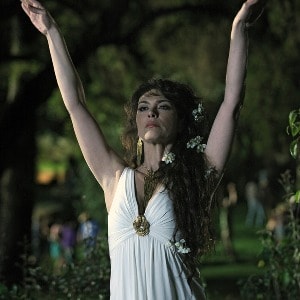
"For whatever reason, every project I do becomes sort of a cult, or a cultish show, you know, like Battlestar, or even a film I did years ago, Kalifornia, people refer to it as a cult film."Michelle Forbes interview.
"This, in a nutshell, is the problem of the aughts. Will all of these newly indispensable textual forms ever lend themselves to actual books, or are they simply ends in themselves?"


