Not about: Bob

It's sad that Robert B. Parker died but his books went long before he did. The early Spenser novels were good but they tailed off. The last one I attempted was Playmates before closing it around page 20 and never picking it up again.

The attraction of writing a series based on one character is obvious and an author must never begrudge another his living. The first half dozen Spenser novels were fine records of time and place, and I still owe them the tip about warming tomatoes before using them in a salad. (Women have told me many times -- Spenser only had to tell me once.) But inevitably any serial fiction will peter out, falling prey to success or jumping sharks. Sir Arthur Conan Doyle hated Holmes; Ian Fleming tried to kill Bond more than once before Bond killed him; James Lee Burke moved Robicheaux around to keep himself entertained, as did Walter Mosley, who jumped around enlivening all sorts of minor characters. Martin Cruz Smith did the best job with Arkady Renko: the latest Renko novel Stalin's Ghostis melodramatic but maintains its predecessors' sparse, surly and deeply intelligent form. (Do readers beyond the crime genre realise how good a writer Smith actually is?)

Raymond Chandler was right to let it all fall apart: the last Marlowe novel Playback is a self-destructing meta-fiction, as if the pages of the earlier books had become jumbled. By that stage he was writing in a stupor: drinking heavily and dictating from the couch until he passed out, then waking up and dictating again, drinking, passing out again and so on. Chandler's secretary sat by 24/7, apparently, stenographer's notebook in hand. Still, a couchside attendant and the deadline pressure of a best-selling series: I should be so lucky. RIP, RBP. I'll always toast you with the salad.

Fullness of Wind

Judy Nylon clarifies Brian Eno's oft-quoted sleeve notes for his 1975 album Discreet Music:
So it was pouring rain in Leicester Square, I bought the harp music from a guy in a booth behind the tube station with my last few quid because we communicated in ideas, not flowers and chocolate, and I didn't want to show up empty-handed. Neither of us was into harp music. But, I grew up in America with ambient music. If I was upset as a kid I was allowed to fall asleep listening to a Martin Denny album…I think it was called "Quiet Village". The jungle sounds, played very softly made the room's darkness caressing instead of empty as a void. Pain was more tolerable. Brian had just come out of hospital, his lung was collapsed and he lay immobile on pillows on the floor with a bank of windows looking out at soft rain in the park on Grantully Road, on his right and his sound system on his left. I put the harp music on and balanced it as best as I could from where I stood; he caught on immediately to what I was doing and helped me balance the softness of the rain patter with the faint string sound for where he lay in the room. There was no "ambience by mistake". Neither of us invented ambient music; that he could convince EG Music to finance his putting out a line of very soft sound recordings is something quite different.
And on singing for John Cale:
The very first time my name appeared on a sleeve was more or less, voiceover with John Cale. I got the job ("The Man Who Couldn't Afford to Orgy") over the telephone... I was at Eno's house painting the walls. [John] called Eno who wasn't home and he got me and I was sort of hired over the phone. I wrote everything I say on the spot because there were no words except the chorus and got paid twenty quid and a line of coke from my best friends Brian and John. I thought only the person who wrote the music was the songwriter. By the time I was next in a studio, I'd learned about publishing.
In 1977 Judy Nylon recorded a montage of sound samples:
...An American expat in 70's London, [Nylon] started recording with Patti Paladin as RAF, using tape solicitations of the police in Germany, accessed by dialing 1166 on the phone in Cologne.
The recordings formed the basis for the Eno-produced Snatch single 'R.A.F.' (1978), which appeared as the B-side to 'King's Lead Hat' off Before And After Science. Says Nylon:
Right after the Schleyer [kidnapping by the Red Army Faction in West Germany in 1977] you could dial 1166 in Cologne and get these pre-recorded police tapes. The German woman's voice in it is a police women in Cologne. And she's saying, "Do you recognize this man's voice?" etc. "If you have any information..." (Search and Destroy #8)
From 'R.A.F.' it's a direct line to Eno and David Byrne's use of voice samples on My Life In The Bush of Ghosts (1981).

My other favourite Brian Eno story is when he rang up Phil Manzanera in the middle of the night because he didn't know how to finish 1974's Taking Tiger Mountain. So Manzanera drove over to Eno's studio and went through the individual tracks -- not the songs, but each track -- and told Eno what they were. ("That's a bass line... That's a chorus...") From that, Eno was able to start assembling the songs.

BBC's Arena will screen a new documentary on Eno tomorrow night in the UK. I wonder if the contributors to his career such as the above will get a mention. (A: One of the contributors is Malcolm Up For Grabs Gladwell so, probably not.)

Work in progress


Message of Love

East London, very late. Been working with the White Album on a big sound system (borrowed) and thinking yeah, actually, 'Birthday' actually is pretty punk insofar as that's what the people making punk were referencing. It must surely have been a template, as much as 'Taxman' anyway - you can hear it in Magazine and the Buzzcocks. Conversely Chris Thomas - also Roxy Music's producer - said he was merely doing glam with the Sex Pistols (layered guitar, no bass) and there are plenty of vids / documentaries around demonstrating the fact. Maybe you and your friends can find some of them online - ask mum or dad to help.

Anyway... So then it was The Pretenders for Chrissie's voice. Debbie Harry was the one you dreamed of but Chrissie Hynde was the one who'd call back. Hopefully dressed as a diner waitress but we'd go for the puffy shirt look as well. All good things. And now it's down to Harold Budd and The Plateaux of Mirror and, after lotsa words, bed. The new ms is all spick and span and ready to go out into the real world. It's raining like crazy and there's a good bar up the road but I've uncovered vodka and the IHT is sitting ready to go and, you know - we're all going to die some day. I say that without rancour.

L.H.O.O.Q


"New research has found that the Mona Lisa’s famed smile is almost certainly ‘forced’ – raising the intriguing possibility that Leonardo deliberately portrayed her that way."

"Italian polymath Leonardo da Vinci's muse for Mona Lisa may have suffered from hypothyroidism, according to an Indian-origin scientist who studied the features of the world-famous portrait. Mandeep R Mehra, from Brigham and Women's Hospital in the US, summarised the possible medical conditions visible in the portrait of Lisa Gherardini, the woman pictured in Mona Lisa, and proposed his own interpretations."

"For centuries, art historians have been troubled by Mona Lisa's enigmatic smile - but, according to one doctor, her cholesterol levels were more worrying. For Dr Vito Franco, from Palermo University, she shows clear signs of a build-up of fatty acids under the skin, caused by too much cholesterol. He also suggests there seems to be a lipoma, or benign fatty-tissue tumour, in her right eye."
-- BBC, 2010

"Recently, it has been speculated that Mona Lisa's famous smile is caused by facial muscle contracture and/or synkinesis after Bell's palsy with incomplete nerval regeneration."
-- Klinikum der Universität Düsseldorf. (article in German)

"It is believed, however, that the Mona Lisa does not smile; she wears an expression common to people who have lost their front teeth. A close-up of the lip area shows a scar that is not unlike that left by the application of blunt force. The changes evident in the perioral area are such that occur when the anterior teeth are lost. The scar under the lower lip of the Mona Lisa is similar to that created, when, as a result of force, the incisal edges of the teeth have pierced the face with a penetrating wound."
-- Journal of Forensic Sciences, 1992

"Why is she looking so sad? . . . She married at the end of 1488 when she came to Milan but she had a big problem. She married her cousin, a beautiful man but he was a drinker, and he had problems with impotence."
-- The Age, 2004

"Researchers studying 3-D images of the “Mona Lisa” say she was probably either pregnant or had just given birth when she sat for Leonardo da Vinci’s 16th-century masterpiece. "
-- Associated Press Sept. 27, 2006

"People have long been fascinated by Leonardo da Vinci's Mona Lisa. Her enigmatic smile has been the subject of debate for centuries, even leading Sigmund Freud to speculate that the painting was actually da Vinci's self-portrait."
-- Medhunters.com

"The Mona Lisa originally had eyebrows, according to a French art expert who has analysed Leonardo da Vinci's masterpiece with a special camera."
-- Telegraph, 2009

"University of Illinois researchers last year used facial-recognition software to analyze the Mona Lisa's enigmatic smile. They concluded the model was happy, with touches of disgust, fear and anger, at least as Leonardo da Vinci painted her, the Champaign (Ill.) News-Gazette reported Tuesday."
-- Physorg.com, 2006

"For centuries, artists, historians and tourists have been fascinated by Mona Lisa's enigmatic smile. Now it seems that the power of Leonardo da Vinci's masterpiece comes in part from an unlikely source: random noise in our visual systems."
-- New Scientist 2004

"What put that smile on the Mona Lisa's face? S-E-X! She was a 16th century hooker!"
-- Weekly World News, 1991

"A male apprentice, longtime companion and possible lover of Leonardo da Vinci was the main influence and a model for the Mona Lisa painting, an Italian researcher said."
-- CBC, 2011

"An Italian researcher says the key to solving the enigmas of Mona Lisa lies in her eyes. Silvano Vinceti claims he has found the letter "S" in the woman's left eye, the letter "L" in her right eye, and the number "72" under the arched bridge in the backdrop of Leonardo da Vinci's famous painting. According to the researcher, the symbols open up new leads to identifying the model, dating the painting, and attesting to Leonardo's interest in religion and mysticism."
-- CBS News, 2011

"On the basis of subjective (thirty-two participants estimated painter–model constellations) as well as objective data (analysis of trajectories between landmarks of both paintings), we revealed that both versions differ slightly in perspective. We reconstructed the original studio setting and found evidence that the disparity between both paintings mimics human binocular disparity. This points to the possibility that the two Giocondas together might represent the first stereoscopic image in world history."
-- Claus-Christian Carbon, Vera M Hesslinger Perception, 2013

"The Mona Lisa was based not just on a Florentine merchant’s wife but also on Leonardo da Vinci’s male apprentice and probable gay lover, an Italian art detective claims. Silvano Vinceti said the portrait, which hangs in the Louvre in Paris, is an “androgynous” amalgam of Lisa Gherardini, the wife of a wealthy merchant from Tuscany, and Gian Giacomo Caprotti, better known by his nickname, Salai."
-- Nick Squires (in Rome)  The Telegraph 21 April 2016

"Perhaps the Mona Lisa had syphilis... If the Mona Lisa is a portrait of someone with a sexually transmitted disease, these hints of death and illness suddenly make sense. As for her half-smile, it becomes a wry acknowledgement that sex can make you sick. This macabre message fits well with Sigmund Freud's analysis of Leonardo. Freud argued in his 1910 book Leonardo da Vinci and a Memory of His Childhood that the polymath researcher who not only painted but also filled notebooks with his scientific studies was repelled by sex. Leonardo was homosexual, he says, but afraid of intercourse with men or women. Instead, he "sublimated" sexuality into research."
-- Jonathan Jones, The Guardian, 2017

Addendum:

"A spring-propelled car that Leonardo da Vinci conceived five centuries ago could have paved the way for the Mars rovers, researchers say."
-- ABC News, 2004

Another city, not my own

As a born and bred Aucklander I have the right to have mixed feelings about my home town if not diss it outright, but sitting here as I am on the other side of the world it's still difficult to watch the feckless wholesale fuck-up that is the Rugby World Cup. More specifically, it's difficult to watch the greed, mismanagement and small-town, me-too overreaching of New Zealand officials who would sell their grandmother and not even at a good price to satisfy their fantastical imaginations about what possible tourists might possibly want from the event. To wit, one Murray McCully, many years in bumbling opposition but now finally with his tiny hands on the tiller, agitating for legislative approval in the dead of summer in order to reshape one of the most beautiful working waterfronts in the world into a typically fucked up, hasty, shit-ass -- let's say it: typically Auckland collapse of architecture. Aucklanders don't need it, tourists don't want it, six out of 13 city councillors can't even be fucked turning up to debate it and the country won't profit from it, but hardworking little eager beaver Murray is pushing for it in what has become trademark National / John Key style: in secret, under the table, behind closed doors, under urgency. This is what Auckland has come to: John Banks as the voice of reason. As always, catching the blood from the stone are local architectural compromisers Jasmax.

It reminds me of certain other well-earning men who fronted up in the 1980s with business talk of a trickle-down economy and "economic benefits" that never materialised for anyone but themselves. Massive over-capitalisation, skyhook "business" jargon, a shit-eating grin, a perennial loss flicked off to the ratepayers and government-funded retirement for Wellington MPs' sunset years while one of the prettiest cities in the southern globe lies pebble-dashed in their wake. Auckland: the boom times are back.

"So you, personally, aren’t a psycho, right?"

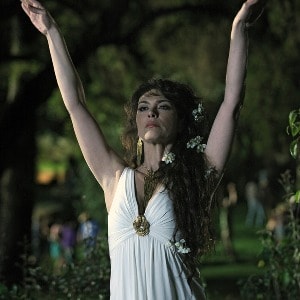
Noir and B-movies are filled with actresses who specialised in one type of role. My favourite horror pin-up is Barbara Steele, she of Black Sunday (AKA The Mask of Satan). I saw it as a kid and was never quite the same way again. Steele always reminds me of Michelle Forbes: both actresses share an underbite, an eight-ball stare and a frangible quality.

In other words, Forbes is a character actor - the exact tool for a certain type of job. Her roles are typically noirish, dead-end and hard to love, but they also have their negative qualities. Forbes has appeared in in 24, Ronald D. Moore's terrific remake of Battlestar Galactica and, most recently, in True Blood. Each time she appears in viewers notice her, say she's really good, and then forget her. But I have a feeling she's going to be on T-shirts for a couple of generations. Here's a quote from the actress and a link to a good interview on New York magazine:
"For whatever reason, every project I do becomes sort of a cult, or a cultish show, you know, like Battlestar, or even a film I did years ago, Kalifornia, people refer to it as a cult film."
Michelle Forbes interview.